FlashForensics AI
Agentic recovery for corrupted flash storage
- 100%
- recall on planted files
- 0
- false positives
- 69
- formats in the index
- 82
- tests passing
“PhotoRec tells you it found 9,000 files. This tells you which 40 are your photos, and why.”
When an SD card’s allocation table dies, the bytes are all still there and nothing knows where any file begins or ends. Signature carvers answer this by handing you nine thousand nameless fragments — most garbage, a few your wedding pictures — with no idea which is which. The bottleneck in data recovery was never finding bytes. It is triage.
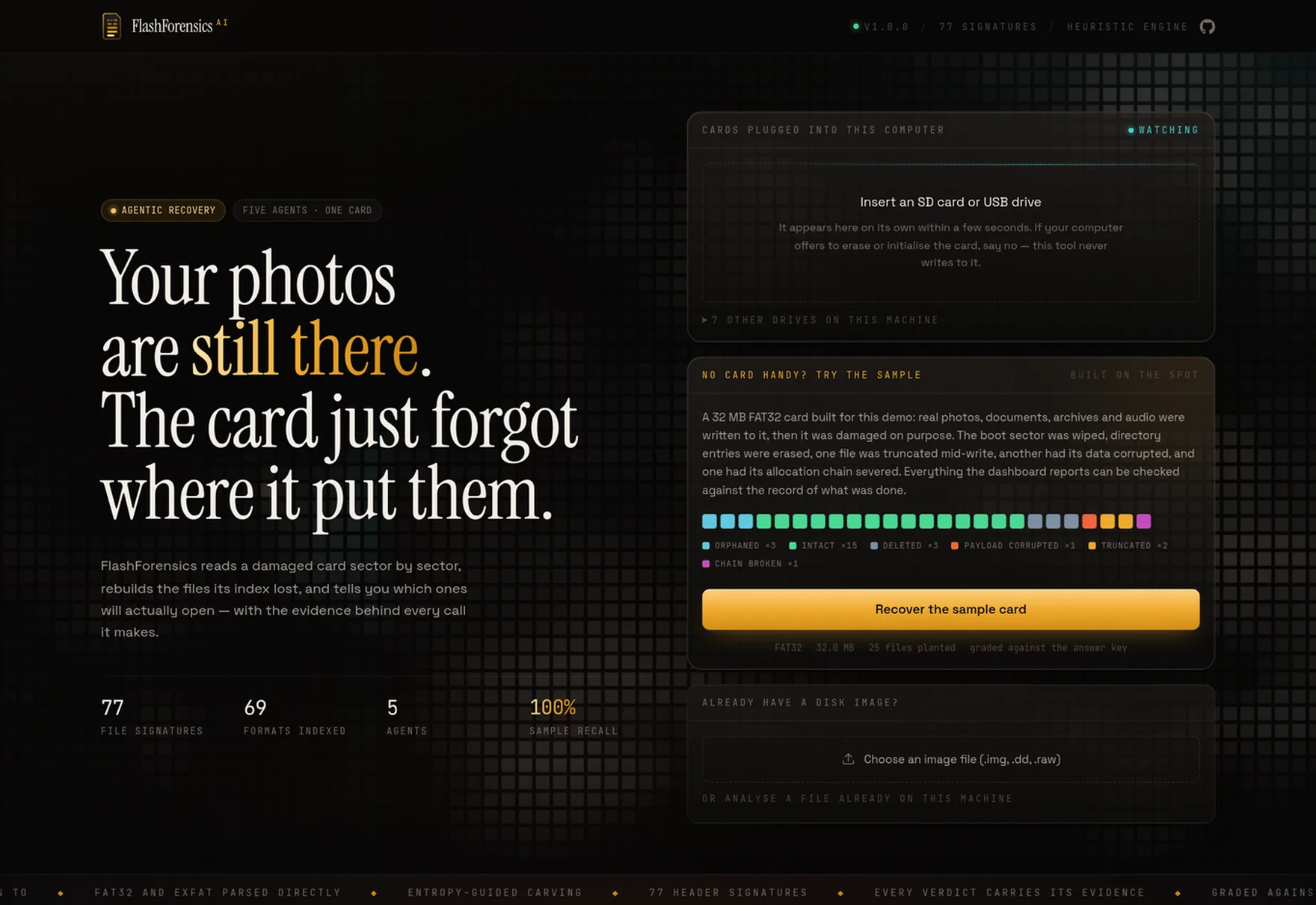
A multi-agent pipeline on LangGraph where each agent owns one stage: a hand-written FAT32/exFAT parser that recovers geometry from the backup boot sector, Shannon-entropy mapping to locate damage, signature carving of orphaned regions, then classification and a recoverability verdict per fragment. Ambiguous signatures — every zip container starts with the same four bytes — are resolved by semantic retrieval over an embedded file-type index rather than a lookup table, with an LLM writing the final verdict.
What makes it
work.
Pure-Python FAT32 and exFAT parsers — no pytsk3, no compiled dependency — that reconcile both FAT copies and record every structural inconsistency as evidence instead of raising on the first one.
One entropy pass over the volume tells carving where to skip; an entropy cliff mid-stream is itself proof a file was truncated.
Structural evidence first, retrieval over a 69-format knowledge base second, a language model only for what those leave open.
Every claim is graded against a manifest of what was really done to the fixture card — the demo is a measurement, not an animation.
In the interface.
05 screensBuilt with.
- Python
- LangGraph
- LLM Agents
- FastAPI
- Embeddings
- Next.js
- TypeScript
The API sleeps on its free tier — the first request after a quiet spell takes about a minute to wake it.